
Plants and care
Trees for small gardens: how to choose without regrets
Vivero de Abril · · 8 min read

In this guide
A one-metre tree will fit in almost any garden. The question is whether it will still fit when its canopy reaches the window, shades the entire table, or approaches the pool. Choosing trees for small gardens starts by imagining that future.
In a Mediterranean garden, besides size, heat, soil, and frosts matter. This guide helps you compare options before buying, whether you plant in the ground or are looking for a tree for a large pot.
Before choosing: measure the canopy you can afford
Measure the free space and mark windows, walls, drains, and walkways. Then think about what you want the tree for: shade for eating, flowers, fruit, or a green presence during the winter. One specimen rarely solves everything.
- Adult height: the size at sale does not indicate the final size.
- Canopy width: this is usually the data that previously limits a small garden.
- Variety and pattern: they can change the vigour; ask for the specific identification.
- Soil and climate: check drainage, exposure, frosts, and irrigation availability.
- Maintenance: account for leaves, flowers, and fruit near the pavement.
A simple test: mark the expected canopy diameter on the ground with a rope. If it invades all the useful space, it is best to look for another variety or a more compact option.
Which tree to choose according to what you need
| Option | When to consider it | What to check |
|---|---|---|
| Lemon tree | Fruit and evergreen foliage in a sunny corner | Rootstock, canopy space, irrigation, and frost protection |
| Compact pomegranate variety | Flowers and Mediterranean character | Variety size and suitability for producing edible fruit |
| Compact cultivar of the Judaea tree | Summer flowering and light passage in winter | Cultivar dimensions, hours of sun, and air circulation |
| Compact selection of the Mediterranean spurge | Evergreen foliage and natural appearance | Adult growth, drainage, and fruit drop |
| Olive tree | Mediterranean focal point with enough space | Future width and maintenance: it is not dwarf by nature |
1. Lemon tree: a useful option if you can manage the irrigation
The lemon tree combines evergreen leaves, aromatic flowers, and fruit. It can fit in a small garden or a large container, as long as it has good light and a climate-appropriate location. We would not choose it for a dark corner or for a garden where no one can check the irrigation in summer.
In the ground, the rootstock and variety condition growth. In a pot, the root volume is limited, but the needs for water and nutrition monitoring increase. A small pot does not turn the tree into a dwarf variety.
You can consult our lemon tree in a pot and the lemon tree care guide. Confirm the format and variety before deciding its final location.
2. Compact pomegranate: check the variety before falling in love with the flower
The pomegranate is an option to consider in sunny spaces. It loses its leaves, so it does not offer a green screen all year round. There are important differences between fruit varieties and compact ornamental selections: do not buy a dwarf form expecting pomegranates like those from a production tree.
If you are looking for fruit, ask about the variety, vigour, and its needs. If you are mainly looking for flowers, you can prioritise a reduced size. The name “pomegranate” by itself is not enough to know how much space to reserve.
3. Judaea tree: summer flower without losing sight of the cultivar
The Lagerstroemia indica can provide flowers and an interesting silhouette during the winter. There are cultivars of very different sizes; for a small garden, that choice is fundamental.
Consider a compact selection with known adult dimensions. It needs a bright location and it is best to avoid enclosed corners without air circulation. By losing its leaves, it lets more light through in winter, something useful near a room, although it does not serve as permanent screening.
4. Compact Mediterranean spurge: green all year round, with room to grow
The Mediterranean spurge, Arbutus unedo, can work as a large shrub or a small tree. The species can reach considerable growth: for a small space, it is interesting to check a compact selection and its expected width.
Before placing it next to an entrance or the edge of the pool, consider the fruit drop. It is also advisable to check that water can drain well. Having a Mediterranean aesthetic does not mean that any soil and any corner are suitable.
5. Olive tree: yes in some small gardens, but with criteria
The olive tree provides a recognisable presence and evergreen foliage. However, it is not a small tree by nature. A young specimen can end up developing a wide canopy in the ground.
It can be considered as a focal point when there is available volume and reasonable maintenance. If to fit it you need to continuously prune the entire canopy, the initial choice probably does not fit. Consult our Mediterranean olive tree and, if you will grow it in a container, the olive tree in a pot guide.
Trees we would not choose right away for a very small garden
Jacarandas, mesquite trees, carob trees, and ginkgos can be magnificent trees, but their usual forms need space in the long term. It is also not advisable to confuse a large-stature magnolia with a compact cultivar. The fig tree deserves special attention next to pavements and pipes due to its growth.
This does not rule them out of all projects. It means that a young and affordable specimen should not be bought assuming it will retain those proportions. In minimal spaces, a shrub formed as a small tree can be more suitable than a large tree subjected to constant pruning.
Roots and distance to the house: avoid “zero problems” promises
There is no universal distance that works for any tree. The species, adult size, soil, and the situation of foundations, pipes, and pavements matter. There is also no general guarantee of “roots that do not lift anything.”
Locate the underground installations before planting and leave space for the trunk, roots, and maintenance. If the spot is next to a pool, a pipe, or a construction, ask for an assessment of the location. Also check the local regulations applicable to planting next to boundaries.
In the ground or in a large pot?
In the ground, the tree has more chances to express its natural size. In a container, you depend more on irrigation, drainage, nutrition, and future transplants. Choose a stable container proportional to the root ball; there is no single number of liters suitable for all species and ages.
On raised terraces, check the allowable load before installing a large container: you must account for the tree, the pot, and the wet substrate. Keep the water outlets clear.
Frequently asked questions before buying
Which small tree provides shade?
Shade depends above all on the canopy. A very narrow tree offers little shaded area. Decide where you want that shade and at what time, and check if the adult canopy fits without occupying the entire garden.
Which one requires little maintenance?
The one that fits the climate, soil, and space. An adapted species that can grow without constant corrections is usually a better choice than another maintained with constant pruning. All need establishment care.
Can I keep any tree small by pruning it?
It is not advisable to base the choice on that. Repeated pruning can alter its shape, generate continuous work, and cause unwanted growth responses. Start with a suitable species and variety.
What data should I send so you can help me choose?
A general photo, space measurements, location, approximate hours of sun, location of pipes or pool, and what you expect from the tree. Also indicate if it will be in the ground or in a pot.
Choose once and enjoy for years
Before buying, answer three questions: how much space will the canopy have, if the climate suits it, and what care you can maintain. With that, the choice becomes much clearer.
At Vivero de Abril we can help you compare options for your space through online gardening advice. If you also need to decide the location and the rest of the planting, consult our garden or terrace design.
Reference links: RHS: trees for small gardens and lemon tree botanical sheet. Dimensions and behavior vary with the cultivar and local conditions; British references do not replace the assessment of the Mediterranean climate.
General guidance. Needs vary with the plant, location and individual condition.
Keep exploring
Back to all guides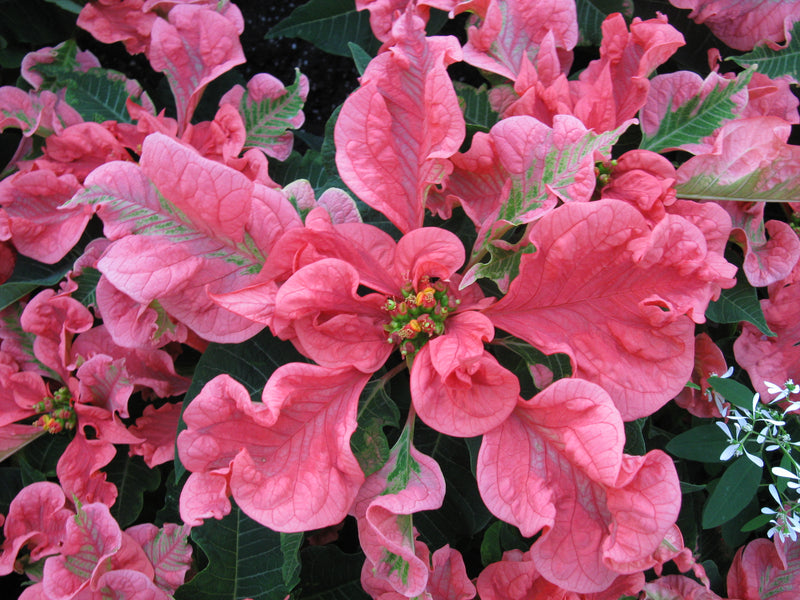
Plants and care
Flor de Pascua: cómo elegirla y cuidarla para Navidad
La flor de Pascua suele entrar en casa entre noviembre y diciembre. La eliges por el color, la colocas donde queda bonita y, a...
5 min readRead guide
Plants and care
Cómo proteger las plantas del frío: cuáles resguardar y cuándo
En noviembre aparece una duda muy concreta: ¿qué plantas pueden seguir fuera y cuáles necesitan resguardo? La respuesta depende de la especie, la exposición...
5 min readRead guide
Plants and care
Mosquitas en la tierra de las plantas: qué son y cómo eliminarlas
Mueves una maceta para regar y salen unas mosquitas oscuras. Al día siguiente vuelves a verlas cerca de la ventana. Antes de rociar toda...
5 min readRead guide